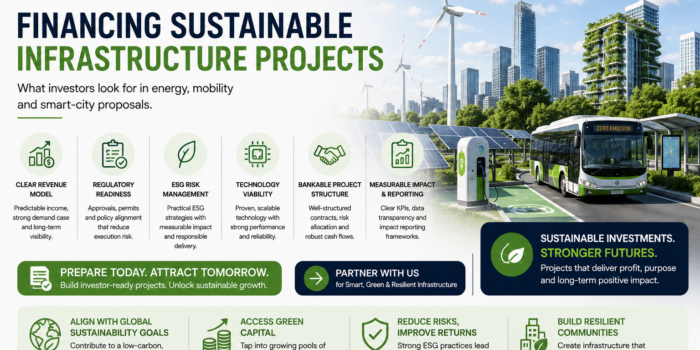

Infrastructure projects can create long-term commercial value, but securing capital is rarely as simple as presenting a strong idea. Developers and contractors seeking infrastructure project financing must demonstrate that a project is technically viable, commercially realistic, properly documented and capable of managing risk over its full lifecycle.
Whether the project involves transport, energy, utilities, logistics, industrial development, public infrastructure or mixed-use construction, investors and lenders will evaluate much more than projected revenue. They want to see an experienced delivery team, clear legal rights, credible cost assumptions, measurable demand and a realistic route to completion.
For businesses preparing to approach financiers, the goal is not only to ask for capital. It is to present an investment opportunity that is structured, transparent and ready for due diligence.
Start With Financial Readiness
Financial readiness begins with a realistic view of the project’s capital requirement. Many proposals struggle because the funding request is based only on construction cost, without properly accounting for land, permits, design, project management, contingencies, interest during construction, insurance, operating reserves and post-completion working capital.
A credible financial plan should show how much capital is required, when it will be required and what the funds will be used for at every project stage.
Developers should prepare a detailed financial model covering projected construction expenditure, operating costs, revenue assumptions, debt servicing, cash-flow timing and expected investor returns. The model must be based on assumptions that can be explained and tested.
Private infrastructure investors are more likely to engage when the numbers reflect practical delivery conditions rather than an overly optimistic best-case scenario.
Build a Strong Feasibility Study
A feasibility study is one of the most important tools in construction project finance. It helps demonstrate whether a project should move forward before significant capital is committed.
A thorough feasibility study should assess the site, demand, technical solution, cost structure, regulatory environment, delivery timeline and potential revenue model. It should also identify the project’s key constraints early, including land access, utilities, environmental approvals, traffic conditions, supply-chain risks and community considerations.
For example, a logistics development may need a detailed review of freight demand, road connectivity, warehouse absorption, labour availability and future expansion capacity. An energy project may need to demonstrate resource availability, grid connectivity, offtake arrangements and regulatory compliance.
Investors do not expect every risk to disappear. They expect the sponsor to understand the risks and have a workable plan to manage them.
For a wider view of how capital opportunities are shaped by infrastructure demand across markets, review this global infrastructure investment perspective.
Define the Right Funding Structure
The funding structure should match the nature, maturity and risk profile of the project.
Some projects are financed mainly through sponsor equity and conventional lending. Others may require a mix of developer equity, private investment, construction debt, project debt, strategic partnerships, government support, grants or long-term concession arrangements.
The right structure depends on factors such as project size, revenue certainty, construction complexity, asset life, regulatory approvals and the availability of contracted cash flows.
A project with stable, predictable revenue may be more suited to long-term debt financing. A development-stage project with greater uncertainty may need equity capital or phased funding before lenders are willing to participate.
Developers should also be prepared to explain the proposed capital stack clearly. Investors need to know who is contributing equity, which parties are taking risk, when debt will be repaid and how returns will be distributed.
Make Risk Allocation Clear
Every infrastructure project contains risk. The quality of the proposal depends on how clearly those risks are identified, allocated and controlled.
Common risk areas include land acquisition, permitting, design changes, construction delays, inflation, material-price volatility, labour availability, weather, demand shortfalls, currency movements and political or regulatory changes.
A strong financing proposal does not simply say that risks will be managed. It specifies who is responsible for each major risk and what protections are in place.
For instance, a fixed-price engineering, procurement and construction contract may reduce certain construction-cost risks. Long-term supply contracts can help manage input volatility. Offtake agreements may improve revenue visibility. Insurance arrangements can provide protection against defined events.
Risk allocation should be commercially fair. If one party is expected to carry every risk without the ability to control it, the funding structure may become difficult to sustain.
Prepare Investor-Ready Project Documentation
Investors and lenders need documents that allow them to evaluate the project quickly and confidently. Incomplete documentation is one of the most common reasons a promising project loses momentum.
A well-prepared financing package may include:
- Executive project summary and investment thesis
- Feasibility study and technical reports
- Detailed financial model and funding requirement
- Land ownership, lease or development-rights documentation
- Permits, licences and regulatory approvals
- Engineering drawings, design concepts and project schedule
- Construction budget and procurement plan
- Revenue assumptions, customer contracts or offtake agreements
- Risk register and mitigation strategy
- Management-team profiles and delivery-track record
- Proposed legal and ownership structure
The documents should tell one consistent story. The project scope, timeline, budget and revenue model must align across every report and presentation.
A useful reference point is the Lethem International Airport development project, which presents infrastructure as a phased programme involving core development, expansion planning and strategic partnership engagement.
Show That Your Team Can Deliver
Capital providers invest in projects, but they also invest in people.
Developers and contractors need to show that their management team understands the sector, has access to the right technical expertise and can manage complex construction or infrastructure delivery.
A strong team profile should explain relevant project experience, commercial capability, financial oversight, engineering support, legal advice and operational knowledge. Where expertise is missing, identify experienced delivery partners, consultants or specialist contractors who can strengthen the project.
For first-time sponsors, credible partnerships can be especially important. An investor may be more comfortable when a new developer works with an established engineering firm, operator, contractor or advisor with a proven record in the relevant asset class.
Understand What Investors Expect
Private infrastructure investors generally want clarity on four areas: risk, return, timeline and exit.
They need to understand what makes the project commercially viable, what could cause it to underperform, how long capital will be committed and how returns will be generated.
Most investor conversations will include questions such as:
- What problem does the project solve?
- Who will use or pay for the asset?
- What approvals are already in place?
- How much funding is needed and in what phases?
- What is the construction timeline?
- Who is responsible for cost overruns or delays?
- What revenue is contracted, forecast or dependent on market demand?
- What is the expected investor return and exit route?
Businesses that answer these questions early are better positioned for productive discussions with project finance consulting partners and potential capital providers.
Common Reasons Infrastructure Projects Struggle to Secure Capital
Many projects do not fail because the underlying idea is weak. They struggle because the investment case is not fully prepared.
Common issues include unrealistic revenue projections, incomplete land documentation, weak cost estimates, missing permits, unclear ownership structures and insufficient evidence of demand. Other projects lose investor confidence because they have no defined risk-allocation plan or rely too heavily on one uncertain funding source.
Another frequent problem is approaching investors too early. A concept may be attractive, but without technical studies, financial modelling, project rights and a capable team, it may still be too risky for serious capital consideration.
The solution is to build readiness before launching a major fundraising process. Each completed document, contract, approval and partnership can reduce uncertainty and strengthen the project’s credibility.
Prepare for Better Financing Conversations
A well-prepared project creates a better conversation with investors. Rather than leading with a broad request for funding, developers should present a defined opportunity with a specific capital requirement, a credible use of funds and a practical delivery plan.
Businesses seeking strategic input can contact New Global Investments to begin a discussion around investment opportunities, business requirements and long-term growth objectives.
Communicating an Investor-Ready Project Clearly
Even a technically strong project needs a clear narrative. Developers and contractors must explain the project’s opportunity, impact, commercial rationale and funding need in a way that investors, partners and stakeholders can understand.
A focused investor relations and financial communications strategy can help businesses organise their investment story, strengthen stakeholder communication and present complex opportunities with greater confidence.
Conclusion
Infrastructure project financing depends on much more than a construction concept or a projected return. Developers and contractors need financial readiness, credible feasibility studies, carefully allocated risk, complete documentation and a delivery team that investors can trust.
The strongest projects are built for due diligence from the beginning. By preparing the financial model, technical case, legal structure and investor narrative before approaching capital providers, businesses can reduce uncertainty and improve their chances of securing the funding needed to move from vision to execution.