
Sustainable infrastructure has moved beyond being a long-term policy ambition. For developers, technology companies, municipalities and project sponsors, it is now a serious investment category covering renewable energy, low-carbon mobility, smart buildings, digital public systems, resilient utilities and resource-efficient urban development.
However, attracting sustainable infrastructure investment requires much more than describing a project as green or smart. Investors want evidence that the project can generate reliable returns, meet regulatory requirements, manage environmental and social risk, and deliver outcomes that can be measured over time.
Whether a proposal involves renewable energy generation, electric-vehicle charging, public transit, smart-grid technology, waste management, water systems or digital urban infrastructure, the strongest funding cases combine commercial discipline with credible sustainability performance.
Start With a Clear Revenue Model
The first question for most investors is straightforward: how will the project generate predictable income?
A sustainable project may create environmental value, but it still needs a commercial model that can support construction, operations, maintenance, debt repayment and investor returns. Project sponsors should explain who will pay, how much they will pay, how long the revenue agreement will last and what could affect demand.
For energy projects, revenue may come from power-purchase agreements, utility contracts, corporate offtake agreements, renewable-energy certificates or regulated tariffs. For mobility projects, income could come from fare collection, leasing, service subscriptions, charging fees, fleet contracts, advertising or availability payments. Smart-city projects may depend on municipal contracts, managed-service agreements, shared savings or user fees.
Investors are more confident when revenue is contracted, diversified or supported by a strong long-term demand case. A proposal based only on high-level growth projections is less persuasive than one supported by signed agreements, customer commitments, tariff frameworks or realistic usage data.
A useful starting point is to understand the wider green-energy investment opportunity and how renewable energy, efficiency and low-carbon systems are becoming part of long-term infrastructure planning.
Show Regulatory Readiness Before Raising Capital
Green project financing often depends on regulatory clarity. Investors need to know that the project can legally be developed, built, connected, operated and monetised in the target market.
A strong proposal should clearly address land rights, permits, zoning, environmental approvals, grid access, utility agreements, operating licences, public-procurement processes and relevant tax or incentive frameworks.
For example, a solar project may require land-use approval, interconnection rights, environmental clearances and a power-sale agreement. An electric mobility project may need local charging permissions, parking arrangements, transport permits and electricity-supply coordination. A smart-city project may require data governance, cybersecurity compliance and public-sector procurement approvals.
Regulatory uncertainty does not always stop investment, but it must be acknowledged. Investors want to see which approvals are complete, which remain pending and how the project team will manage each approval risk.
ESG Risk Must Be Practical, Not Just Promotional
Environmental, social and governance considerations have become an important part of infrastructure due diligence. But investors do not expect every project to be perfect. They expect the sponsor to identify material ESG risks and manage them responsibly.
Environmental risk may include carbon intensity, land impact, water use, waste, biodiversity, pollution, climate exposure and construction emissions. Social risk may include community engagement, land acquisition, labour practices, affordability, accessibility and the impact on local livelihoods. Governance risk may include procurement integrity, data privacy, management capability, reporting quality and contract transparency.
A credible ESG approach should include clear policies, measurable targets, responsibility within the project team and a process for monitoring performance after financial close.
For sustainable infrastructure investment, generic claims such as “eco-friendly” or “green” are not enough. Investors need to understand the project’s actual footprint, how risks are being reduced and how impact will be tracked.
Prove That the Technology Is Viable
Technology can make energy, mobility and smart-city projects more efficient. It can also introduce execution risk.
Investors will assess whether the technology is proven, commercially available, maintainable and suitable for the conditions in which the project will operate. A solution that performs well in one city or climate may not automatically work in another.
Project sponsors should explain the technology architecture, supplier track record, maintenance plan, warranties, integration requirements, cybersecurity controls and replacement-cycle assumptions. They should also be ready to show how the technology performs at scale.
For example, a smart-grid proposal should explain how data will be collected, protected and used to improve grid performance. A mobility platform should show how software, payment systems, fleet operations and charging infrastructure will work together. An energy-storage project should address battery life, degradation, fire safety, operating controls and end-of-life handling.
A strong proposal does not overstate innovation. It demonstrates why the technology is appropriate, bankable and operationally realistic.
Smart-City Projects Need a Clear Public Benefit
Smart-city investment opportunities often combine physical infrastructure with digital systems. They may include intelligent traffic management, smart lighting, waste optimisation, air-quality monitoring, public-safety systems, integrated mobility platforms, digital citizen services or predictive maintenance for public assets.
The challenge is that technology alone does not create a strong investment case. Investors need to understand the real-world problem being solved.
A traffic-management system should show how it can reduce congestion, improve travel time or lower fuel consumption. A smart-water project should show how it can reduce losses, improve billing accuracy or strengthen supply reliability. A public-safety platform should demonstrate operating value, governance safeguards and service outcomes.
The strongest smart-city proposals connect technology to an outcome that governments, businesses and residents can recognise. Smart-city infrastructure insights show why mobility, infrastructure monitoring, governance, environmental management and digital inclusion must work together rather than operate as isolated technology initiatives.
Public-Private Partnerships Can Strengthen Project Delivery
Public-private partnerships, commonly known as PPPs, can be important for projects that require public assets, regulatory support, long operating periods or essential-service delivery.
A PPP structure may combine public-sector objectives with private-sector financing, technical expertise, operational capability and performance accountability. It can be used for transit systems, public lighting, water infrastructure, social infrastructure, renewable-energy facilities, waste-management systems and digital-city programmes.
However, investors need clarity on the contract structure. They will look at concession length, payment mechanisms, demand risk, termination provisions, step-in rights, inflation adjustments, force-majeure protection and dispute-resolution processes.
A good PPP does not transfer every risk to one party. It allocates each risk to the participant best able to manage it. Construction risk may sit with the contractor, policy risk may remain with the public authority and operational-performance risk may sit with the operator.
Clear risk allocation makes a project more financeable because it reduces uncertainty around costs, responsibilities and long-term cash flow.
Measure Social and Environmental Outcomes
Investors increasingly want to know what changes the project will create beyond financial return. For sustainable infrastructure, the ability to measure outcomes can be a major advantage.
Depending on the project, relevant metrics may include:
- Carbon emissions avoided or reduced
- Renewable energy generated
- Energy saved through efficiency measures
- Reduction in water losses or waste sent to landfill
- Improved public-transit access or reduced journey times
- Jobs created during construction and operation
- Households, businesses or communities served
- Air-quality improvement or reduced fuel use
- Accessibility improvements for underserved communities
- Asset uptime, service reliability and resilience performance
The best project sponsors establish a baseline before construction begins. They then define realistic targets, identify how data will be collected and report performance consistently after implementation.
Measurable outcomes help investors, public partners and communities understand whether the project is delivering on its promise.
Build a Bankable Project Package
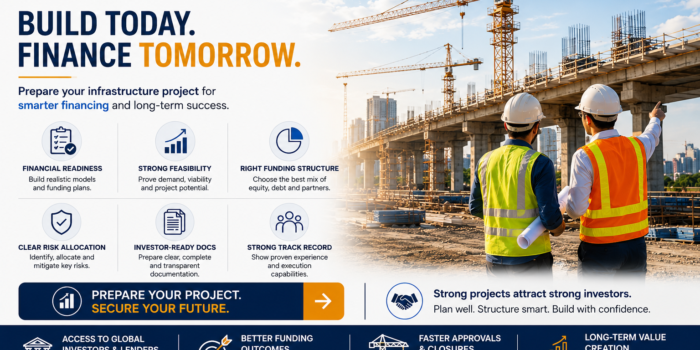
A sustainable infrastructure proposal should be easy for an investor to review. The project package must connect the commercial opportunity, technical approach, regulatory position, financial model and impact story.
A complete funding package may include a project summary, market-demand analysis, feasibility study, engineering plan, capital-expenditure budget, operating model, risk register, ESG assessment, legal structure, permits, contracts, management-team profile and investor-return model.
The project should also explain its funding requirement in phases. Some projects may need early-stage development capital before seeking construction debt. Others may require a combination of sponsor equity, private investment, grants, concessional capital, strategic partnerships and long-term project finance.
The more organised the information is, the easier it becomes for energy project investors and infrastructure financiers to begin due diligence.
Common Reasons Green Projects Fail to Secure Funding
A promising sustainable concept may still struggle to secure funding if it is not investment-ready.
Common weaknesses include unclear revenue assumptions, unproven technology, incomplete permits, unrealistic construction budgets, weak maintenance planning, missing offtake contracts and vague sustainability claims. Projects may also lose credibility when they fail to explain who will own the asset, who will operate it and how risks will be shared.
Another challenge is trying to raise capital before the project is sufficiently developed. Investors are more likely to engage when a sponsor has already completed key studies, secured site rights, identified delivery partners and validated the commercial model.
The goal is to reduce uncertainty before the investor conversation begins.
For sponsors planning future-ready assets, long-term infrastructure trends highlight the importance of resilience, digitisation, sustainable design, public-private partnerships and supply-chain planning.
Present the Project With Investor Confidence
Even a well-designed project can struggle if its investment case is poorly communicated. Investors need a clear narrative that explains the opportunity, the return potential, the project’s risk controls and the measurable impact it will create.
An effective investor presentation should answer four questions clearly: Why this project? Why now? Why this team? And why is the proposed funding structure appropriate?
A professional corporate website with investor-relations capability can help project sponsors present documents, milestones, ESG information, investor updates and project credibility in a more structured and accessible way.
Conclusion
Sustainable infrastructure investment depends on more than environmental ambition. Investors look for strong revenue potential, regulatory readiness, sensible risk allocation, proven technology, credible public-private partnership structures and measurable social or environmental outcomes.
For energy, mobility and smart-city proposals, the most financeable projects are those that combine commercial clarity with practical sustainability performance. By preparing the technical, financial, legal and ESG case early, project sponsors can build stronger investor confidence and improve their chances of securing green project financing.